

Set the stamp count and the reward
You decide how many stamps redeem what, and whether a stamp counts per visit or per specific item.
Features
Stamp cards on WhatsApp keep the buy-9-get-1 mechanic guests already know, but nothing gets lost, nothing gets faked, and you keep the full visit data.
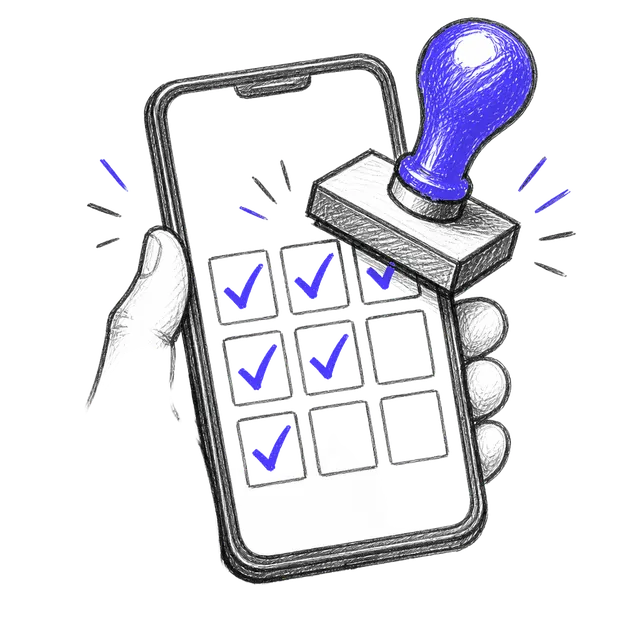
Updated August 2026 — Digital stamp cards keep the mechanic guests already know — collect enough stamps, redeem a reward — but the card lives on WhatsApp, so it can't be lost, crumpled, or stamped by a friend. Guests open it to see how many stamps remain, and every stamp records a real visit for you.
Updated: 2026-08-09
You decide how many stamps redeem what, and whether a stamp counts per visit or per specific item.
No staff member has to hold a stamp. Guests scan a table QR code or photograph their receipt, and the stamp is added instantly.
Guests tap redeem in their membership card; you confirm at the counter, or the voucher applies automatically to an online order.
Same mechanic, but guests can't lose it, staff can't get asked to fake a stamp, and every stamp creates a visit record you keep — something a paper card never gives you.
No. The card lives on WhatsApp in Singapore and Malaysia, WhatsApp or Messenger in the Philippines, Zalo in Vietnam.
No, except when a guest redeems a reward at the counter. Stamps are added when guests check in or scan a receipt, so rush hour doesn't bottleneck at the till.
Yes. Rewards can be redeemed in-venue or applied directly to an online order, with nothing the guest needs to bring in.
Yes. For example one card for morning coffee and another for lunch items, each with its own milestone.
PEKO and LOOP are two products from the same company. PEKO is the AI retention layer and runs alongside the POS you already use. LOOP is the AI-native POS that covers operations: recipe-level inventory, staff shifts, table plans and the kitchen display. Each works on its own, and run together they share one dataset, so nothing has to be entered twice. See PEKO + LOOP in one ecosystem